Independent app review · Evidence checked August 31, 2026
Tiimo review 2026: a genuinely useful visual planner?
Tiimo treats “get ready” as a sequence that can be seen and timed, not one vague task on a list. That makes it meaningfully different from Todoist or Reminders, though the extra guidance also creates more interface to learn.
 Tiimo
TiimoOur take
Is it worth using?
Tiimo is worth trying when transitions, routines and seeing the next step are more difficult than remembering a list exists. It can support executive function, but it is not a medical treatment and its navigation takes time to understand. Structured is better for a free-form visual day; TickTick is better when tasks and focus sessions matter more than routines.
Inside the apps
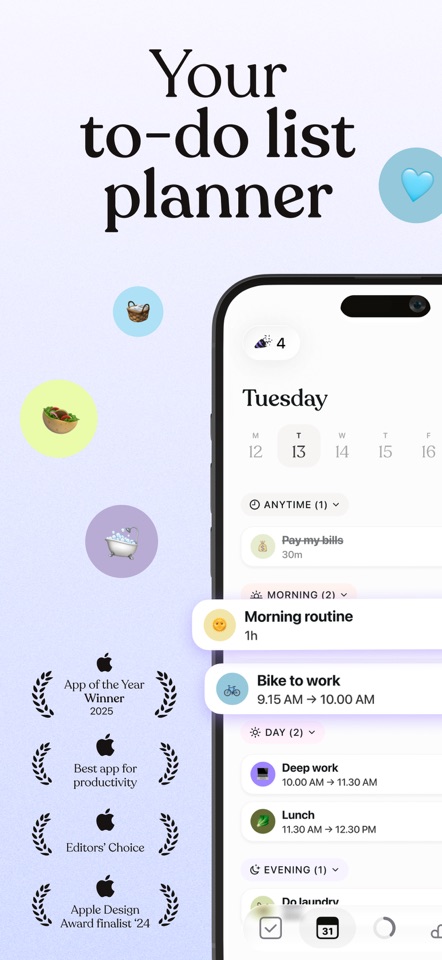
What they actually look like
These screenshots come from the apps' current App Store listings. They are not mockups we made for the article.
What users report
What starts to matter after a week
We read recent reviews for Tiimo to look for praise and friction that product pages leave out. They are anecdotes, not a vote, so they challenge our testing rather than decide the verdict.
Positive reviews describe using Tiimo alongside existing support. Critical reviews say the navigation can be difficult to understand at first.
The quick version
The differences that matter
- Best for
- Visual routines, transitions and step-by-step days
- Price model
- Free download with an optional subscription
- Main strength
- Turns vague routines into visible sequences
- Main weakness
- Navigation and setup can feel unfamiliar
- Clinical status
- A planning tool, not a treatment
- Best alternative
- Structured for timelines; TickTick for tasks and focus
A routine is more useful when its steps are visible
“Get ready for work” can hide breakfast, medication, clothes, a packed bag and leaving on time. Tiimo can show those steps in order and make the transition less dependent on remembering the whole sequence at once.
That is different from adding five subtasks to a conventional project. The visual presentation is the point, particularly when the next action needs to be obvious without opening a dense list.
The day can feel guided without becoming a strict timetable
Plans, routines and focus views can give the day a visible rhythm. For some people that reduces the energy spent deciding what comes next. For others it may feel like another system asking to be maintained.
Start with one difficult transition rather than rebuilding every morning and evening. A useful routine should remove decisions. If setup creates more decisions than the routine used to, simplify it.
ADHD-friendly does not mean universally helpful
Tiimo is often discussed in relation to ADHD and autism. The design may help with time, sequencing and external cues, but people with the same diagnosis can need very different levels of structure.
Positive reviews describe using the app alongside existing support. Critical reviews say the navigation can be hard to understand at first. Both are more informative than a blanket claim that the app is “for ADHD.”
It is not the best home for a large project inventory
Tiimo is strongest close to the present moment. A complicated work project with dozens of dependencies, files and collaborators belongs in a more conventional task or project tool.
It can still sit beside that system. A work project may contain the commitments, while Tiimo turns today’s selected actions into a sequence a person can actually begin.
Flaws, but not dealbreakers
The interface is more opinionated than a normal list, and the subscription is difficult to justify if you use only basic reminders. Initial setup can also become an ambitious project in its own right.
Tiimo earns a recommendation by solving a narrower problem than “store my tasks.” Try it with one real routine and judge whether the next step becomes easier to see.
Good to know
A few common questions
Is Tiimo only for people with ADHD?
No. It is a visual routine and planning tool that may help anyone who benefits from clearer sequences and time cues.
Is Tiimo a medical treatment?
No. It can support planning and routines, but it does not diagnose or treat ADHD, autism or any health condition.
What is the best Tiimo alternative?
Structured is a simpler visual timeline. TickTick combines tasks with habits and a focus timer. The better choice depends on whether routines or task management is the main problem.
Sources
Where we checked the facts
We use the app maker's own pages for prices and features. Reviews and community posts are useful for spotting problems, but one person's experience is still one person's experience.
- 01OfficialTiimo product informationView source
- 02App StoreTiimo US App Store listingView source
- 03App StoreRecent Tiimo US App Store reviewsView source